
Mother Cord. Part 1

My mother was a World War 2 orphan. This one is loaded and will take me many posts to unpack.
My mom died in January of 2015. The last nine years of her life I was married and had two kids. All those years she would regularly send me letters with directives about raising children and taking care of my health. There were progressively fewer questions and more “this is what you should do” lists in the letters. Here’s a shorter sample from when my daughter was 6 and my son was 1,5 years old. My father had died about three years prior, and my mom had a little over two years left to live. She was suffering from heart disease and living with my alcoholic brother at that point. This is translated from Russian.
Naden’ka* and family!
I believe you will find this useful. Naden’ka, don’t be angry with me and just pick what’s most important. I believe there’s something useful for raising kids and for your recovery after giving birth. I assume there’s a lot of useful stuff for all of you here. Devote all of your free time to your children; get them used to physical challenges, independence, kindness, etc. Don’t overload them with food; don’t worry–they will only be stronger. The little one needs to stop nursing. All this is difficult, but it’s about time. And he should sleep in his own bed. Do it, just do it. He will be calmer and it’ll be easier on all of you. He won’t love you less. I love you all very much.
Everything is normal** with me. Well, there’re moments, but life has taught me to overcome them. Your brother is working. We are preparing for the winter.
Take care of the elders***, pay more attention to them, be nice to them, and find time to see them.
That’s it. Sending you hugs. Your Mom and Grandma.
These letters made me feel disappointed, embarrassed, and slightly insulted. “Devote all of your free time to your children”??? What free time? My then husband and I were sleep deprived and on edge with each other. On top of taking care of my family, I was dealing with new health issues and figuring out how to find proper medical support…On a deeper, less conscious level, I felt pain that the letters not only didn’t bring any sense of closeness but actually added to our distance. I read through them quickly and put them away, not sure whether I should keep or just toss them. I like to keep letters, but these just didn’t seem worth it. Every now and then I would wonder about them and conclude that this was due to her unfortunate lack of education. And that it was just how she was, a construction boss in her past.
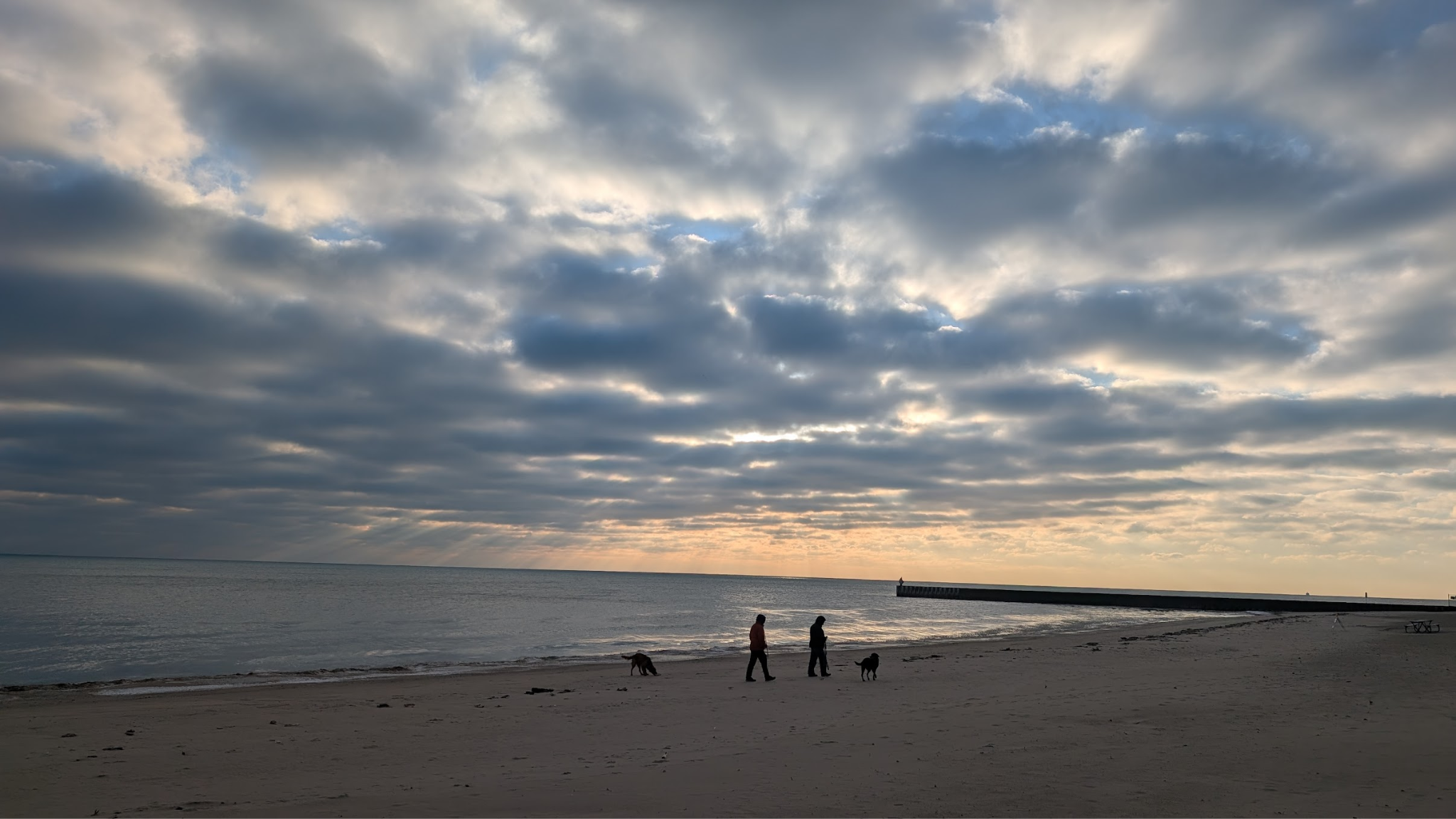
But a few days ago something dawned on me while I was on a walk along lake Michigan. I was talking with my daughter, a college freshman, on WhatsApp. She was sharing with me how she regularly felt ashamed of herself for no particular reason. I was listening–compassion, pain, and guilt welling up in my chest. “Ah how I have failed her!” The familiar dirt path through a field of wilted grass under my feet was getting hard to see through my fogged up glasses. I slowed down to a stop, closed my eyes, and allowed the pain to be there.
And there it hit me: my mom’s letters were her way of dealing with just this kind of moments: the moments of pain for what had been lost or irreparably screwed up. The void of orphanhood starting at the age of 5 or 6. The horror of begging in the streets with her three brothers, the youngest of whom never made it. The darkness of raising children with a man who was docile when sober but terrifying when drunk, and drunk he was often. The horror of having seen her 15 old son, her gentle and shy first born, jump at his father with a knife. The sorrow, in the last 10-15 years of her life, of watching that same son perish from alcoholism, lose wives, jobs, basic decency…spend his days sitting with other bruise-covered drunks on a bench near the town bus stop, empty bottles strewn around... Those letters were her desperate attempt to fix the horror, to patch the void.
To get back to the conversation with my daughter, I opened my eyes and looked left at Lake Michigan behind the row of boulders. It was greenish grey and pretty tame. Its translucence made me think that soon enough I would be able to submerge myself in its lovely fresh water. In its “sweet water”, agua dulce, as they call it in Spanish. I looked up at the gulls swiping the sky and took a deep breath. I was ready to listen again.
I have cried several times since that occasion, and every time it has felt like I am grieving my mom’s grief too. Is this what they call clairsentience? I have a skeptical part that says, “Don’t look for cute new-agey words for your experiences!” And I am grateful to this part because I do want to find my own language for what I feel. But besides what it really was, it made me think that taking care of my voids and sorrows helps my children have space to feel their own.
My therapist suggested that I was not only freeing up space for my daughter but also for my mom. My therapist practices IFS, and IFS can get pretty woowoo. And I have skeptical parts. But it makes sense: if my mom were alive, and I told her, “I understand and I forgive,” she would likely feel she could relax a bit and stop trying so hard to fix. With encouragement from my therapist, I send this to my mom, wherever she may be: “Mom, I understand and I forgive. And I love you.”
What does this act do for me and to me? It gives me space to grieve and love her. I wonder, am I ever going to be done with grief? Is it going to be just love in the end? Or is grief not a stage, but something like love, which is always with us?
For the context: three years ago I initiated a breakup with my husband of 17 years. Since that day, I have gone through a lot of pain, confusion, joy, and self discovery. My growing understanding of my mother, her wound, and our shared wound has been a part of that process. I am currently in the process of a divorce.
* Naden’ka is a tender nickname for “Nadia”. The apostrophe means that the “n” sound is soft, kind of like in the word “diminutive”.
** “Normal” is the equivalent of “OK” in Russian.
*** She likely meant my ex-husband’s parents.